
When you’re managing a busy construction or commercial project, the last thing you want is a lift bringing everything and everyone to a halt. Unfortunately, daytime lifting often means exactly that. Congested sites, restricted access, busy public spaces and tight deadlines can turn even a straightforward lift into a logistical headache.
That’s where evening and weekend lifting can help. More businesses are choosing out-of-hours crane hire to keep their projects moving with less disruption, more control and greater efficiency. But is it right for your site? What should you consider? And how do you plan an out-of-hours lift safely? We talk through this in the blog below.
Why does out-of-hours lifting work so well?
Think of your site at 10am on a weekday. Trades are moving around, deliveries are arriving, foot traffic is high, and access routes are already tight. Now compare that to a Saturday morning or a weekday evening. Everything is calmer, quieter and more controlled; some may say perfect conditions for lifting.
Out-of-hours operations typically offer:
- Clearer access and easier set-up without vehicles, contractors or pedestrians in the way.
- Improved safety because fewer people are on-site and risks are reduced.
- Faster lifting times, as crane teams can work without navigating live site activity.
- Less disruption to surrounding businesses, especially in busy commercial areas and city centres.
Even one well-planned weekend lift can shave days off a schedule that would otherwise be slowed down by daytime restrictions.
How out-of-hours lifting reduces disruption
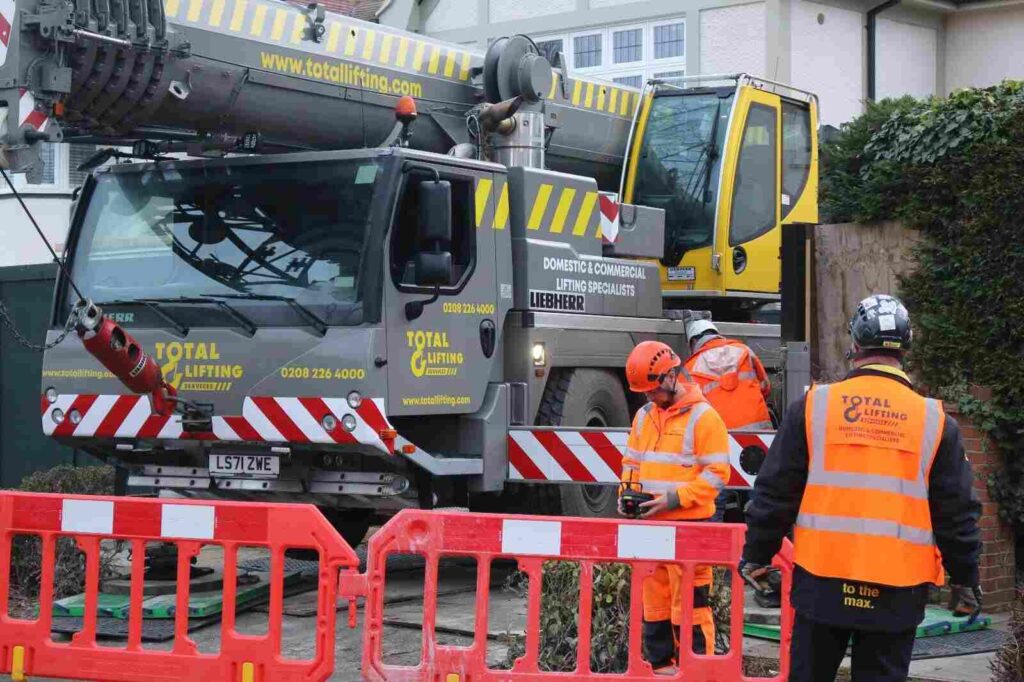
1. Keeping your site moving
A daytime lift often means pausing activity around the lifting zone. That could be shutting down an entire area, stopping a mechanical plant or halting foot traffic. These stop-start moments add up quickly.
Out-of-hours lifting removes this friction. Work can continue during normal hours, while the lift is handled separately when the site is quiet. It’s a smoother, more efficient workflow, and far easier to manage.
2. Minimising impact on your neighbours
Whether your project is next to a shop, office block or residential street, nobody enjoys noise, blocked pavements or road closures. By carrying out lifts in the evening or at weekends, you reduce the inconvenience and are far more likely to avoid complaints or delays caused by restricted access.
Local authorities also tend to prefer out-of-hours applications for this reason; it keeps the public safe and minimises disruption to busy areas.
3. Better coordination with deliveries and traffic
If you’re lifting plant, steel, HVAC units or large materials into place, the delivery vehicles need space too. Daytime congestion can make this tricky, especially in city-centre or retail locations.
Out-of-hours scheduling means:
- Delivery vehicles can arrive without queues or obstructions
- Positioning the crane becomes quicker and easier
- Road closures (if needed) are simpler to arrange
In short, the whole operation becomes far more predictable.
What types of projects benefit the most?
Evening and weekend lifts are particularly effective for:
- Retail and hospitality sites where daytime disruption directly impacts customers.
- Busy commercial developments with heavy foot traffic and multiple contractors on-site.
- City-centre builds where access is limited and local authority restrictions are strict.
- Industrial units and warehouse installations where plant needs to be lifted into position without slowing down operations.
- Refurbishment projects where daytime noise and access limitations make lifting difficult.
If your project relies on maintaining smooth daily operations, out-of-hours lifting is often the most practical approach.
Planning an out-of-hours lift: what you need to know
Do you need different safety considerations?
The safety standards are the same, but the planning can be even more thorough. Working after hours often means reduced ambient lighting, fewer people on-site and colder temperatures, so your lift plan will take all of this into account.
Expect your lifting provider to assess:
- lighting requirements
- access routes and exclusion zones
- traffic management
- communication methods for reduced-staff environments
- noise restrictions
- weather considerations
A contract lift (where everything is handled for you) is especially useful for evening and weekend jobs, as the paperwork, planning and supervision are fully covered by the lifting team.
What about staffing?
Depending on your site, fewer of your own team may need to be present. In some cases, a representative onsite is enough while the contract lift team handles the operation.
Your lifting partner will tell you exactly who needs to be there and when.
How early should you plan?
For evening and weekend lifts, slightly earlier planning is always helpful, mainly for:
- securing road closure permits
- arranging traffic management
- booking the correct crane size
- coordinating delivery schedules
That said, experienced lifting teams are used to working flexibly and can accommodate tight timelines when required.
Are out-of-hours lifts more expensive?
Not always. While there may be additional costs for staffing outside normal hours, many clients find the overall project cost is lower because:
- Productivity isn’t interrupted
- Delivery schedules aren’t delayed
- Access and setup are quicker
- Fewer hours are spent managing site restrictions
In many cases, the time saved outweighs the additional out-of-hours fee, especially on projects with strict handover deadlines.
Is out-of-hours lifting right for your project?
If you’re unsure, ask yourself a few quick questions:
- Would a daytime lift interrupt work or slow contractors down?
- Does your site sit in a busy area with high footfall or traffic?
- Is there limited space for crane set-up during normal hours?
- Are you working to tight deadlines where every hour matters?
If you answered “yes” to any of the above, evening or weekend lifting is worth considering.
Ready to keep your project moving with minimal disruption?
Out-of-hours lifting is one of the most effective ways to protect your schedule, reduce downtime and keep your site running smoothly, especially in busy commercial environments. With the right planning and an experienced lifting team, even the most complex evening or weekend lift can be completed safely, efficiently and with far less disruption to everyone around you.
If you’re exploring evening or weekend lifting options or want expert guidance on planning your next lift, get in touch, and the team will be happy to help.